
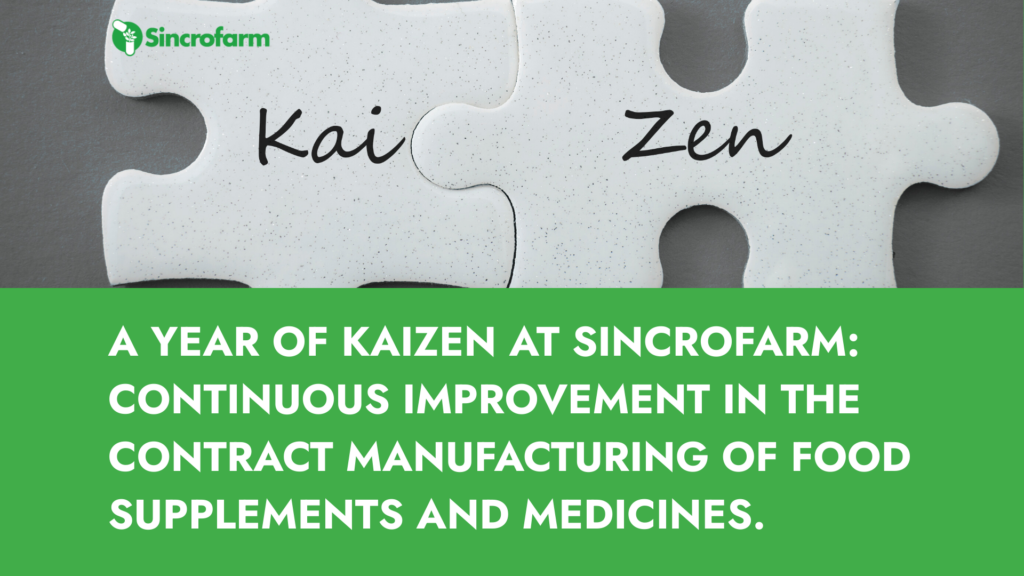
Just over a year ago, at Sincrofarm we took an important step: we incorporated the Kaizen philosophy, one of the pillars of Lean Manufacturing, into our daily work in a structured way. Kaizen is a Japanese term that literally means:
- Kai (改): change
- Zen (善): good, for the better
Not as a one-off project or isolated initiative, but as a new way of working: observing processes, working as a team, and making data-driven decisions.
Today, after twelve months, the outcome is clear: Kaizen is a slow, demanding, and constant journey, but also a solid and profoundly transformative one.
Kaizen: a philosophy that goes beyond tools
This philosophy is particularly well suited to regulated industrial environments such as pharmaceuticals and food supplements, which are typical of third-party manufacturing. It is not about change for change’s sake, but about understanding processes, standardizing them, measuring them, and improving them, always putting people at the center.
From the outset, at Sincrofarm, as a third-party manufacturer of food supplements and medicines, we were clear that Kaizen had to be adapted to our industrial reality, our culture, and our teams. And that has been a key factor in the progress of the project. The actions and changes that are implemented must work for the team and, in many cases, be designed by and for the team.
Daily Kaizen: when improvement is part of everyday life
One of the first projects to be launched was Daily Kaizen, implemented in production, maintenance, and logistics. It is a way to start the day as a team, looking at what we will work on, how we will do it, and what we need.
In these dynamics, day-to-day operational aspects are reviewed and what was planned is compared with what was actually executed. What we mark in red is not a failure, it is an indicator of a deviation or problem that was not considered and, therefore, an opportunity for improvement in the next production run by identifying and solving the root cause.
Throughout the first year, more than a hundred improvement actions have been generated, many of which have already been completed with positive results, while others are still in the analysis or validation phase. Kaizen does not seek speed, but consistency.
Everything parameterized, everything visible
One of the major advances has been the commitment to process standardization. The goal is for any trained person to be able to understand a line, make the correct adjustments, and not depend on the tacit knowledge of a few.
This provides multiple advantages:
- Greater operational robustness.
- Lower risk of errors.
- Facilitates training and versatility.
- Ensures that critical tasks are not forgotten.
A year of challenges: a realistic perspective
The aim of this philosophy is to gradually create positive habits that will have an effect in the medium to long term. But… what have we experienced in the short term?
In the short term, a great effort has been made to first understand this philosophy and then communicate it correctly. When implementing so many changes, some resistance was to be expected. It involves taking people out of their comfort zone, which can elicit different reactions.
To address this challenge, the application of Kaizen itself has proven to be the solution. Thanks to extensive initial communication and improved internal communication, results have begun to emerge. Objective data has helped those who found it most difficult at the outset to take the final step.
On the other hand, the frenetic pace of everyday life is not compatible with a change in philosophy and processes of this magnitude. We managed to understand the need for change before making the decision to start this project. Our confidence that we would see positive results in the long term has paid off sooner than expected. It has been necessary to focus on key projects and processes in order to implement the changes correctly and continue moving forward with greater strength and direction.
People, data, and continuous improvement in GMP environments
If there is one key lesson learned after this first year, it is that Kaizen is, above all, about people. Resistance to change is natural, but listening, testing, and letting the data speak for itself has been the best way to move forward without generating unnecessary noise.
Today, Kaizen is part of the internal conversation at Sincrofarm. Not as a fad, but as a tool for analyzing data, proposing improvements, and building more robust processes through teamwork.
The journey continues. There are projects underway, others in the definition phase, and much learning ahead. But the foundation has been laid: an organization that observes, measures, and continuously improves.
Because in continuous improvement applied to the contract manufacturing of food supplements and medicines, true success is not about getting there fast, but about never stopping.